

Passing the Baton: The Game of Community Leadership
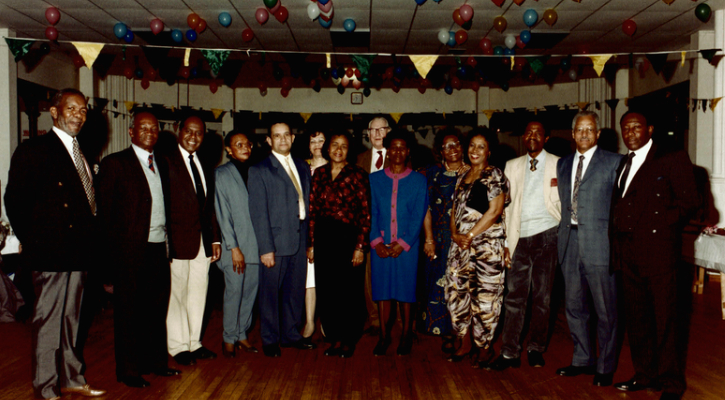
Trinity Hall, West Indian Parents & Friends Association c 1990s
By Emma Harvey, CEO, Trinity Community Arts
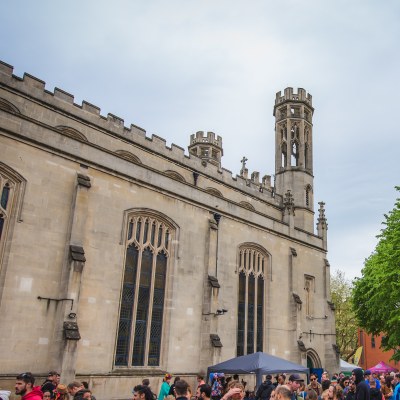
This year marks 50 years of Trinity as it morphed from a religious to a secular space. For all the ways the world has changed over this time, the challenge of saving our spaces remains. It's a tale as old as time, underpinned by a few determined individuals trying to hold onto a vision of something better, in spite not because of the conditions that enable them to do so.
One of those stories from Trinity’s origins is about a man called Roy. Long before community ownership became part of a national conversation, Roy's vision was a bold one. In today’s context, to see an old church serve some other purpose like a music venue or a climbing centre is quite ordinary. In 1976, the idea that someone might turn a former house of God into a hub for communities, culture and learning was a systemic shift in power and purpose.
Like many radical thinkers, Roy's ambitions became burdened by the realities of managing and maintaining a crumbling old building while paying down a commercial mortgage. By 1984 the pressure was too much and The Trinity Hall social experiment ended with Midlands Bank repossessing the building. At the time the blame for this failure rested firmly on Roy’s shoulders. Rumours were rife he’d stolen all the dosh and fled town, though the real story was far more mundane to the point of Shakespearian tragedy: Roy had spent his own money trying to keep this dream alive and died broke and living with relatives in Clevedon.
Community leadership isn't transactional, it's relational.
I tell Roy's story because community leadership isn't transactional, it's relational. People do this work because they care deeply about place, culture, history and future. That hope beyond being rational keeps the vision moving forwards when the money runs dry. Communities evolve. People come and go. Memories fade. Stories are told and retold through different lenses and all the while the challenge remains as to how to adequately resource this work for the long-haul? It's all-consuming, born from a desire to address injustice and improve lives. But once set in motion, the struggle doesn't end there. Everyone has a stake in that future and so expectations can become impossible to meet. This is especially true for Black-led organisations, where leaders are expected to absorb more, do more with less and carry burdens that would be unthinkable in institutions with generational wealth and decades of embedded infrastructure, investment and support behind them.
I've seen versions of Roy's story play out across Bristol's community sector. St Pauls Carnival is one example - held up alongside Bristol's Balloon Fiesta as one of the city's staple annual events, with a historic legacy spanning almost 60 years and a massive economic impact to boot. And yet, time and again I've watched dedicated people trying to deliver something extraordinary whilst balancing rising safety requirements, limited resources and competing community expectations. Anything less than excellence is treated as individual failure rather than the predictable outcome of asking communities to carry responsibilities of the civic and social that a wider system fails to adequately resource. If nothing else this should serve as a need for us all to have a degree of caution before wading in with the worst suspicions of our Roys, who are sticking their necks out to save the civic and social.
We need to stop mistaking that community strength for infinite capacity.
Community-led initiatives should be celebrated for their joy and resilience. But we need to stop mistaking that community strength for infinite capacity. If roads, schools and public transport are recognised as core infrastructure, then the spaces and organisations that sustain civic life deserve better. Expecting communities to absorb ever greater responsibility without comparable investment is neither realistic nor sustainable. Crossing fingers is for buying lottery tickets.
We describe this type of work as a marathon not a sprint when community asset development is closer to a relay race or perhaps a triathlon, except the course is not set and your shoelaces are tied together. There is a desire for great diversity of thought leadership, whilst rarely investing in the conditions that make it sustainable. Leadership is imperfect, personal and learned through experience, at a time when every mistake becomes a public reckoning that risks burning through the very courageous people we need most in these challenging times.
Funders are, by necessity, risk averse. They invest where they believe there is stability, governance and the ability to deliver legacy. As significant resources are being mobilised around agendas that seek to fragment rather than strengthen civic life, there is an equal urgency to invest in the people, institutions, spaces and relationships that hold communities together. This is not about one group, event or building. It is about the wider civic and cultural ecology that allows traditions to be passed between generations, with the elders who share their knowledge, young people who adapt and iterate, and communities who build meaning together. Without investment in that ecology, heritage narrows, leadership burns out and soon there's no one to pass the baton onto.
It feels like the moment is right to bring together the collective resources, skills and expertise that already exist.
With the Government making noise about localism and devolved investment, coupled with sustained third-sector campaigns around resources for community ownership (and even Communities Against Delinquent Ownership (CADO)) it feels like the moment is right to bring together the collective resources, skills and expertise that already exist, so responsibility is shared equitably and not burdened on the narrowest shoulders. We are all operating in conditions of uncertainty and precarity, under constant scrutiny so we need to change tactics if we're to prevent further the fire-sale of our publicly owned assets. Across the pond, the launch of a Historic Preservation Defence Fund - to mobilise resources as a response to the rapid deconstruction of the country’s own heritage by the very institutions meant to safeguard it - should serve as a warning as to what may lie ahead if we continue to leave our community and cultural inheritance to chance.
That baton of our collective future was never meant to be carried by individuals in perpetuity
That baton of our collective future was never meant to be carried by individuals in perpetuity. The measure of our societal health is not how long a weary few can hold back the tide during periods of political change, rather something held by many hands, that is weathered together and passed on with care and forethought. That race of life will not be won by the Roys alone. It's about all of us channelling our inner Roy towards a shared goal; that courage to imagine something different and the determination to keep going when the odds aren't stacked in our favour. Better still, for those with the power to do so to make the road ahead a little smoother by creating the conditions that allow the art of the possible to become a reality.
Fifty years ago, Roy set course for a future Trinity that those who originally built it could never have imagined. The Trinity of today exists because others chose to carry that vision forward, against all the odds, one day at a time. Our responsibility is not to carry the baton forever, but to pass it on in a better state then when we started so the people of tomorrow get the chance to dream at all.
How you can help
Back Locality's campaign to resource Community Ownership:
https://locality.org.uk/news/back-community-ownership-at-the-budget
Peeved about a derelict building on your doorstep? Register it with CADO:
Manage a community asset? Complete Power to Change's latest survey:
https://www.smartsurvey.co.uk/t/communityassetfinance/
Nominate local heritage at risk through Historic England's Heritage at Risk programme: https://historicengland.org.uk/advice/heritage-at-risk
Join the Heritage Alliance's Heritage Manifesto campaign, calling for stronger support for heritage, regeneration and community-led stewardship: https://www.theheritagealliance.org.uk